Sara Wager Astrophotography
  • Recent images
  • Images Gallery
    • Interesting images
  • About me
    • Star People article
  • My Blog
  • Latest Dual rig adventure
  • Astro Pixel Processor tutorials
  • Asteroids and me.....
    • How to find asteroids
    • How to create an asteroid time lapse
  • My observatory
    • The observatory rebuild
    • Equipment
    • Light pollution and astro darkness
  • My guide to image capture
    • Real world comparison - Kodak / Sony chip
    • Dual imaging set up
    • Creating an inset in Photoshop
    • Artistic one channel processing
    • Rubbish in, Rubbish out - you decide
    • Image process tutorials
    • Start / finish - Processing is THE key
    • Building a mosaic >
      • SGPro - Creating a mosaic in software
    • The difference in RGB and Ha light
    • The benefits of extra subs in graphics
    • Narrowband information
    • To bin or not to bin...
  • Equipment reviews
    • PrimaLuceLab Eagle S
    • All things ODK 10
    • PrimaLuceLab PLUS mounting system
    • Avalon linear guide settings
    • Starting out with the Avalon StarGO - Fitting and connecting to a PC
    • Avalon StarGO - Setting a custom park
    • Mallincam All Sky
    • Aviosys IP Power 9258 4 port
    • Avalon M-Tre mount
  • My published images
  • Links
  • Other Astrophotographers
  • Useful books
  • Write in my Guestbook
    • Contact me

NGC7000 & IC5070 - The North American and Pelican nebula
Picture

NGC7000 & IC5070 in Narrowband

Picture
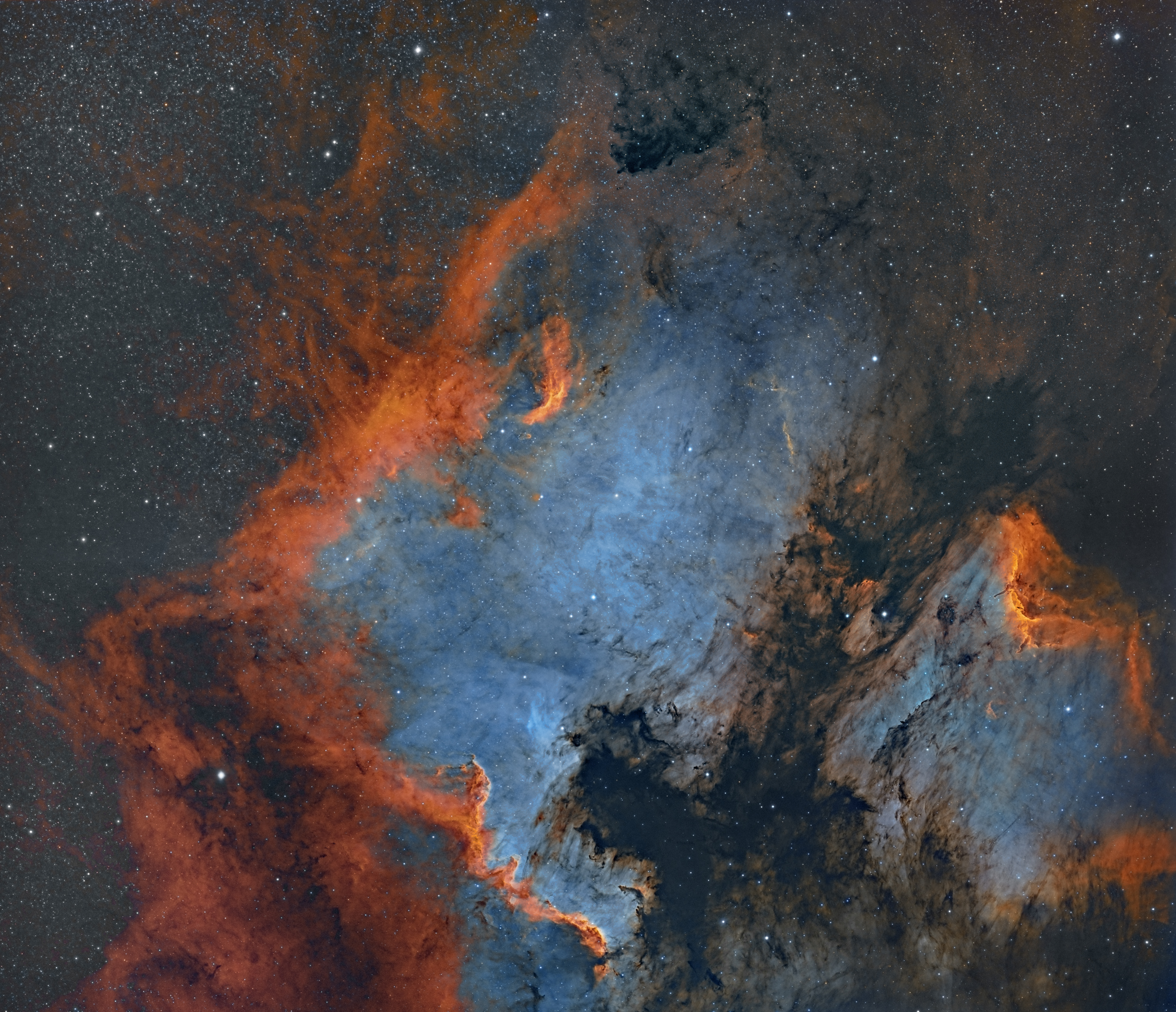
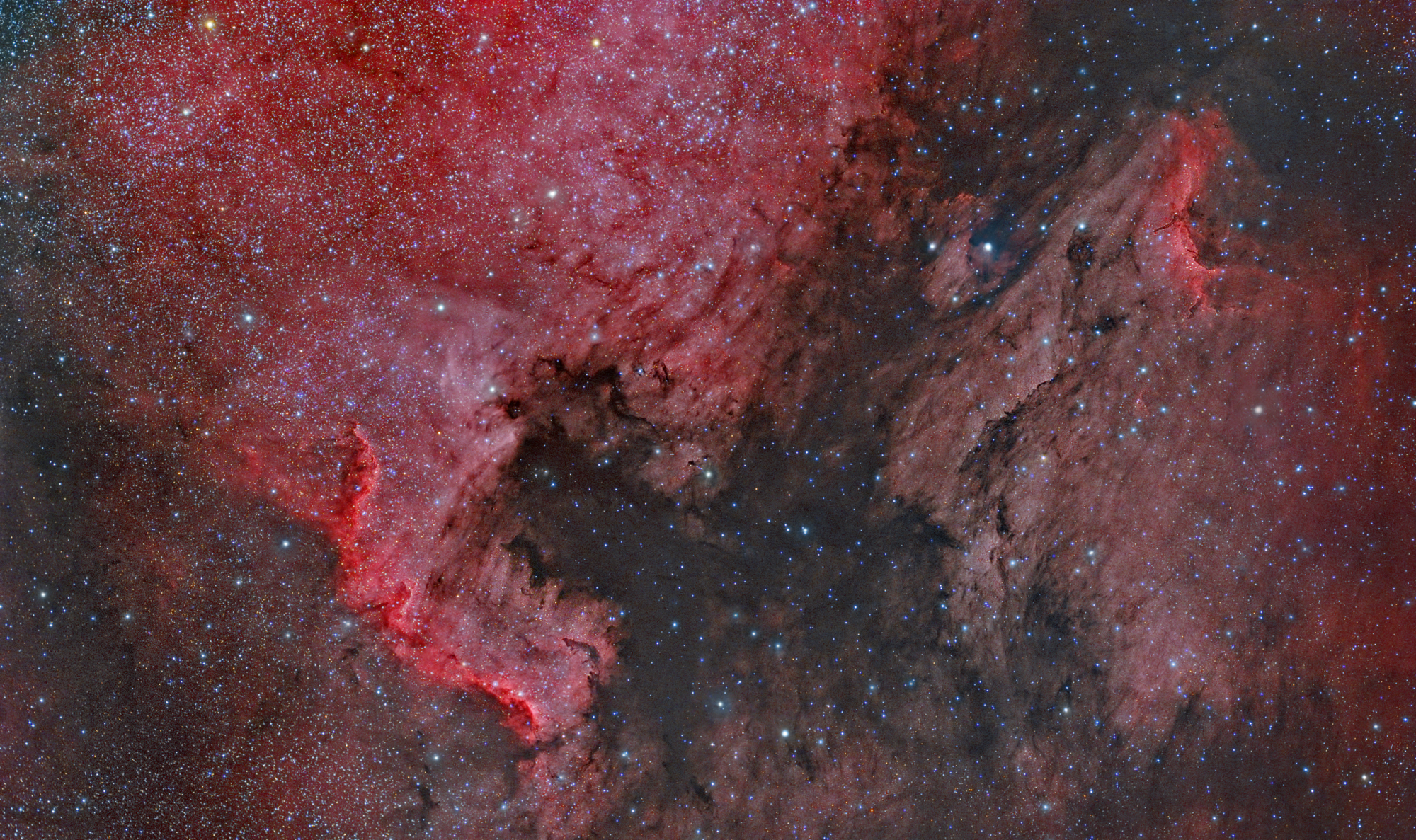
The North America Nebula (NGC 7000 or Caldwell 20) is an emission nebula in the constellation Cygnus. The remarkable shape of the emission nebula resembles that of the continent of North America, complete with a prominent Gulf of Mexico. The North America Nebula is large, covering an area of more than four times the size of the full moon; but its surface brightness is low, so normally it cannot be seen with the unaided eye. The North America Nebula and the nearby Pelican Nebula, (IC 5070) are in fact parts of the same interstellar cloud of ionized hydrogen. The distance of the nebula complex is though to be approx 1800 light years away.

Details
M: Avalon Linear Fast reverse
T: Takahashi FSQ85 0.73x
C: QSI690-wsg with 3nm Ha filter and Starlight Express Trius M25C

This is a 2x2 pane mosaic for the Ha data
29x1800s in Ha and 35x600s with the OSC camera.
​Details
M: Avalon Linear Fast reverse
T: Takahashi FSQ85 0.73x
C: QSI690-wsg with 3nm Ha filter


This is a 2x2 pane mosaic
29x1800s in Ha
30x1800s in OIII

Total exposure time 29 hours and 30 minutes
Picture
Picture
Powered by Create your own unique website with customizable templates.
  • Recent images
  • Images Gallery
    • Interesting images
  • About me
    • Star People article
  • My Blog
  • Latest Dual rig adventure
  • Astro Pixel Processor tutorials
  • Asteroids and me.....
    • How to find asteroids
    • How to create an asteroid time lapse
  • My observatory
    • The observatory rebuild
    • Equipment
    • Light pollution and astro darkness
  • My guide to image capture
    • Real world comparison - Kodak / Sony chip
    • Dual imaging set up
    • Creating an inset in Photoshop
    • Artistic one channel processing
    • Rubbish in, Rubbish out - you decide
    • Image process tutorials
    • Start / finish - Processing is THE key
    • Building a mosaic >
      • SGPro - Creating a mosaic in software
    • The difference in RGB and Ha light
    • The benefits of extra subs in graphics
    • Narrowband information
    • To bin or not to bin...
  • Equipment reviews
    • PrimaLuceLab Eagle S
    • All things ODK 10
    • PrimaLuceLab PLUS mounting system
    • Avalon linear guide settings
    • Starting out with the Avalon StarGO - Fitting and connecting to a PC
    • Avalon StarGO - Setting a custom park
    • Mallincam All Sky
    • Aviosys IP Power 9258 4 port
    • Avalon M-Tre mount
  • My published images
  • Links
  • Other Astrophotographers
  • Useful books
  • Write in my Guestbook
    • Contact me